
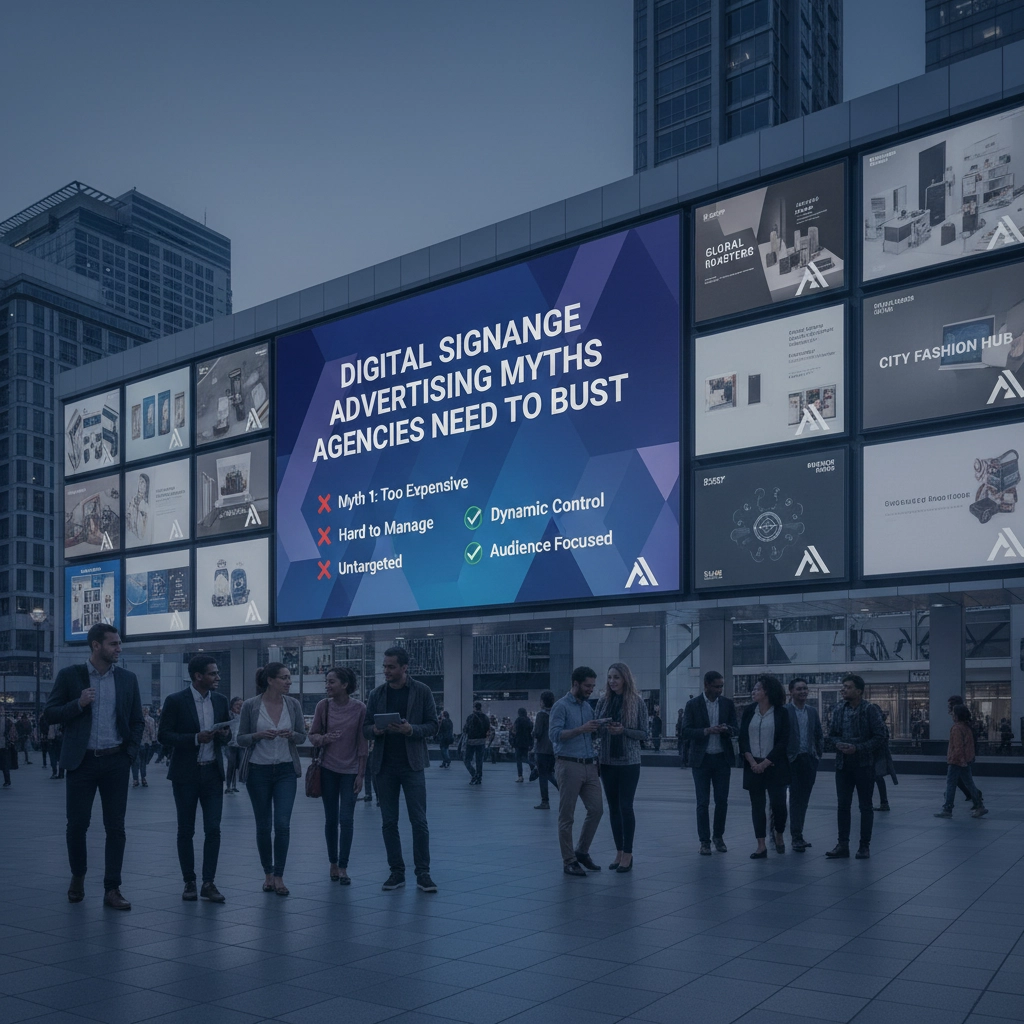
Digital signage advertising continues to face stubborn misconceptions that prevent agencies and brands from maximizing this powerful marketing channel. Despite proven effectiveness and technological advances, outdated beliefs persist in boardrooms and strategy meetings across the industry. It's time to separate fact from fiction and understand what modern digital out-of-home (DOOH) advertising really offers.
These myths don't just limit creative possibilities: they cost agencies real opportunities to deliver exceptional results for their clients. Let's examine the most persistent misconceptions and reveal the truth behind effective digital signage campaigns.
Myth 1: Digital Signage Requires Massive Budgets
The Reality: Modern platforms make digital advertising accessible to businesses of all sizes
The biggest barrier agencies face when pitching digital signage isn't technical: it's the persistent belief that only Fortune 500 companies can afford effective campaigns. This misconception stems from early digital billboard pricing models that required substantial minimum spends and long-term commitments.
Today's digital signage landscape operates differently. Advanced targeting capabilities mean you can run hyper-focused campaigns that reach specific audiences without paying for unnecessary impressions. Instead of broad demographic targeting, modern platforms allow precise business location advertising within customizable radius parameters.

Smart budget allocation focuses on strategic placement rather than volume. A well-targeted campaign reaching the right audience at the right moment consistently outperforms scattered, high-volume approaches. This shift from quantity to quality makes digital signage viable for local restaurants, medical practices, and retail stores: not just national brands.
The key lies in understanding that effective digital signage advertising isn't about covering every screen in the market. It's about identifying high-value locations where your target audience naturally congregates and delivering compelling messages at optimal moments.
Myth 2: Digital Campaigns Are Too Complex to Manage
The Reality: User-friendly platforms simplify campaign management and optimization
Many agencies shy away from digital signage because they assume campaign management requires specialized technical expertise. This fear often stems from experiences with early platforms that demanded extensive training and constant technical support.
Modern digital advertising platforms prioritize ease of use without sacrificing sophistication. Campaign setup, content scheduling, and performance monitoring happen through intuitive interfaces that marketing professionals can master quickly. Real-time adjustments, audience refinements, and creative updates occur with minimal technical overhead.
The complexity myth also overlooks automation capabilities that reduce manual management tasks. Advanced platforms handle scheduling optimization, weather-based adjustments, and performance-driven content rotation automatically. This automation doesn't replace strategic thinking: it amplifies it by handling routine optimization tasks.

Geographic targeting exemplifies this simplification. Instead of complex demographic modeling, agencies can target specific venues, business types, or locations within flexible radius parameters. Want to reach coffee shop customers within five miles of a retail location? Set the parameters and launch. The platform handles the technical implementation while you focus on creative strategy and performance analysis.
Myth 3: Only Large Enterprises Benefit from Digital Advertising
The Reality: Small and mid-size businesses often see the highest ROI from targeted campaigns
The assumption that digital signage only works for major brands ignores fundamental changes in audience behavior and campaign targeting capabilities. Small businesses actually possess advantages that larger enterprises often struggle to replicate: intimate knowledge of their local market, agile decision-making, and direct customer relationships.
Local businesses understand their customers' daily routines, preferred gathering spots, and decision-making triggers better than national brands ever could. This knowledge becomes incredibly powerful when combined with precise business location advertising tools that can target specific venues within customizable distances.
Consider a family restaurant competing against national chains. While the chains run broad awareness campaigns, the local restaurant can target sports bars and entertainment venues within a ten-mile radius during specific events, reaching potential customers when they're already thinking about dining options. This hyper-targeted approach often delivers better conversion rates than mass-market campaigns.

The flexibility of modern platforms also suits smaller business needs perfectly. Campaign budgets, timing, and creative content can adjust rapidly based on seasonal changes, special events, or inventory levels. Large enterprises often require extensive approval processes for campaign modifications that small businesses can implement immediately.
Myth 4: People Ignore Digital Signs
The Reality: Dynamic content captures significantly more attention than static displays
The belief that consumers have developed "banner blindness" toward digital displays misunderstands how people interact with dynamic, contextually relevant content. Research consistently shows digital signage captures 400% more views than static alternatives when implemented strategically.
The key difference lies in relevance and timing. Static billboards present the same message to every viewer regardless of context. Dynamic digital displays can adapt content based on time of day, weather conditions, local events, or audience demographics. This contextual relevance transforms passive viewing into active engagement.
Motion naturally draws human attention, but effective digital signage goes beyond simple animation. Strategic content rotation, real-time information updates, and location-specific messaging create viewing experiences that feel helpful rather than intrusive. When content provides value: whether entertainment, information, or timing-sensitive offers: audiences engage willingly.
The "ignore factor" also diminishes significantly with proper placement and audience targeting. Digital signs positioned at natural decision points: near entrances, in waiting areas, or along commuting routes: reach audiences during moments of natural attention rather than competing for forced focus.
Myth 5: Digital Signage Only Works for Brand Awareness
The Reality: Modern platforms excel at driving direct response and measurable actions
Many agencies limit digital signage to upper-funnel brand awareness campaigns because they assume measurement capabilities remain primitive. This approach undervalues digital advertising's capacity for driving immediate actions and measurable conversions.
Advanced targeting capabilities enable remarketing, sequential messaging, and audience journey optimization that rivals digital advertising's most sophisticated tools. Campaigns can target previous visitors to specific locations, create message sequences that guide decision-making, and adjust creative based on audience response patterns.

Integration with mobile technology amplifies direct response capabilities. QR codes, location-based mobile triggers, and proximity marketing create seamless bridges between outdoor viewing and digital engagement. These connections enable precise attribution and conversion tracking that traditional outdoor advertising cannot match.
The targeting precision available through modern platforms also supports account-based marketing approaches. Instead of broadcasting generic messages, campaigns can target specific business locations where key prospects work, shop, or gather. This precision transforms digital signage from a brand awareness tool into a direct marketing channel.
Myth 6: Outdoor Digital Advertising Faces Too Many Restrictions
The Reality: Strategic placement and compliance knowledge open significant opportunities
Regulatory concerns prevent many agencies from exploring outdoor digital advertising opportunities, but these restrictions are often overstated or misunderstood. While regulations exist, they typically focus on traffic safety and community standards rather than blanket prohibitions.
Most restrictions apply to specific locations: near airports, highways, or residential areas: rather than comprehensive bans on digital displays. Understanding these geographic limitations allows agencies to identify compliant placement opportunities that still reach target audiences effectively.
The key lies in working with platforms that handle compliance monitoring and placement verification automatically. Instead of navigating complex regulatory frameworks independently, agencies can focus on campaign strategy while the platform ensures adherence to local requirements.
Weather resistance and technical reliability have also improved dramatically. Modern outdoor displays withstand harsh conditions while maintaining consistent performance. This durability reduces maintenance concerns and ensures campaign continuity regardless of environmental challenges.
Myth 7: ROI Measurement Is Too Difficult
The Reality: Attribution capabilities rival digital advertising's most advanced analytics
The perception that digital signage offers limited measurement capabilities stems from traditional outdoor advertising's notorious attribution challenges. Modern digital platforms provide detailed analytics that enable precise ROI calculation and campaign optimization.
Location-based attribution connects outdoor exposure to subsequent online actions, store visits, and purchase behavior. This connection allows agencies to demonstrate clear cause-and-effect relationships between digital signage exposure and client business objectives.

Real-time performance monitoring enables continuous optimization rather than post-campaign analysis. Agencies can identify high-performing creative elements, optimal scheduling windows, and audience segments that drive the strongest response. This ongoing refinement improves campaign performance throughout the flight rather than waiting for end-of-campaign insights.
Integration with existing marketing analytics platforms streamlines reporting and attribution modeling. Instead of maintaining separate measurement systems, digital signage data flows into comprehensive marketing dashboards alongside other channel performance metrics.
The Strategic Advantage of Hyper-Targeted DOOH
Modern digital signage advertising succeeds because it combines the visual impact of traditional outdoor media with the precision and measurement capabilities of digital marketing. This combination creates opportunities for agencies to deliver campaigns that build brand awareness while driving measurable business results.
The evolution from broad demographic targeting to precise business location advertising represents a fundamental shift in outdoor marketing strategy. Instead of hoping the right audience sees your message, you can ensure it reaches potential customers during optimal decision-making moments.
Successful agencies embrace this precision as a competitive advantage. While competitors rely on outdated assumptions about digital signage limitations, forward-thinking agencies leverage advanced targeting capabilities to deliver exceptional client results.
Target marketing through digital displays isn't just about reaching more people: it's about reaching the right people at the right moments with messages that drive action. This strategic approach transforms digital signage from an awareness tool into a comprehensive marketing channel that supports every stage of the customer journey.
Ready to leverage hyper-targeted digital advertising for your clients? Contact RAMM to discover how precise business location targeting can transform your campaign performance and deliver measurable ROI that exceeds traditional advertising approaches.

