
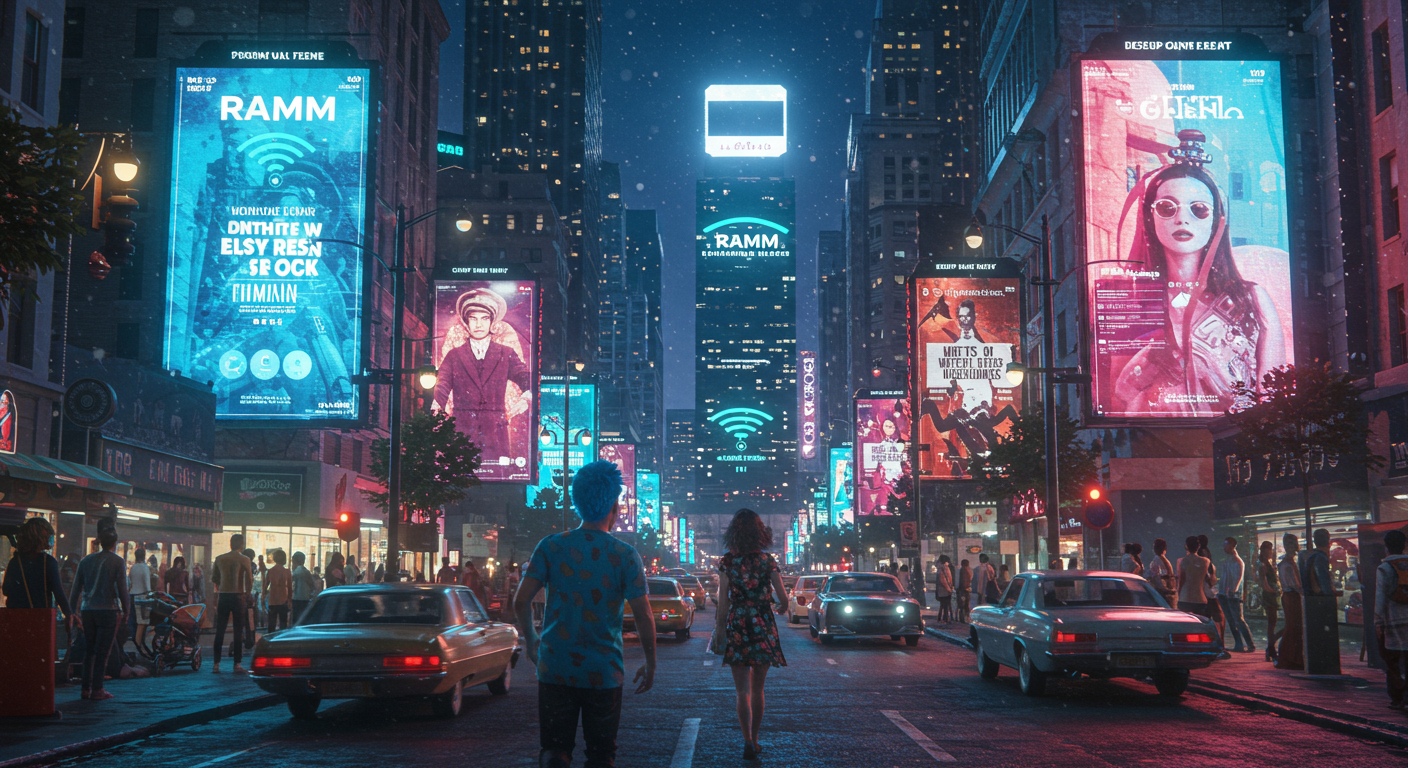
Stop treating local advertising as a broad awareness exercise. Choose the right business locations, place your message near the moment of decision, and give nearby shoppers a clear reason to choose you.
That is the power of conquesting in the real world.
Conquesting uses business location advertising, venue targeting, and digital out of home media to reach consumers near competing stores, restaurants, offices, or other commercial locations. Instead of waiting for shoppers to find your brand, you appear where they are already considering a purchase.
With RAMM, you can target any venue, business, or digital sign within a flexible radius. You can run continuous campaigns, activate custom daily schedules, and adjust creative around events or weather conditions. The result is a more precise form of hyper-targeted DOOH built for real-world action.
Start With the Location That Matters Most
Begin by identifying where your competition is already attracting valuable customers.
You might target:
- A competitor’s grocery store
- A restaurant district
- A shopping center
- A sports bar
- A medical office cluster
- A transportation hub
- A business park
- A retail corridor
- A specific digital sign near a high-value venue
The key is to focus on locations connected to your customer’s purchase journey. A consumer near a competing grocery store may be comparing prices and product selections. Someone outside another restaurant may be deciding where to eat. A patient near a medical office may be searching for a pharmacy, wellness provider, or related service.
Use venue targeting to place your message in the physical environments where those decisions happen.
RAMM helps you choose the specific venue, business, or screen you want to reach. You are not limited to a general city or an entire media market. You can build a campaign around the locations that create the strongest opportunity for your brand.
That precision turns local advertising into an active growth strategy, helping you compete for attention at the point where intent is already high.
Use Radius Targeting to Control Your Competitive Reach
Set your geographic boundaries with purpose.
RAMM supports flexible radius targeting from 2.5 to 50 miles, allowing you to match your campaign area to your business model, customer behavior, and competitive landscape.
Use a tighter 2.5-mile radius when:
- Your customers make quick, nearby decisions
- You operate in a dense urban area
- Your store is close to several competitors
- You want to focus on immediate foot traffic
- Your offer depends on convenience or speed
Expand toward a 10-, 25-, or 50-mile radius when:
- Customers travel farther for your product
- You serve a regional trade area
- Your business has fewer locations
- You are building awareness before entering a market
- Your product category involves more research
For example, a quick-service restaurant may benefit from a tight radius around nearby competitors during lunch and dinner. A specialty retailer, healthcare network, or automotive brand may need a broader radius to reach customers who are willing to travel.
Do not assume that larger targeting always creates better performance. Start with the locations most likely to produce action, measure results by area, and expand when the data supports it.
Make the Message Relevant to the Competitive Moment
Location alone will not win the customer. Your creative must explain why your brand is the better nearby choice.
Use concise messaging that highlights your strongest differentiator:
- Better value
- Faster service
- Greater selection
- Easier parking
- Longer hours
- A limited-time offer
- A nearby alternative
- A product benefit your competitor does not provide
Keep your tone confident without making unsupported claims about another business. You do not need to criticize the competition. Show customers what they gain by choosing you.
Directional copy can also make your ad more useful. Consider messages such as:
- “Fresh options just around the corner.”
- “Your next stop for faster service.”
- “More choice near the shopping district.”
- “Find your local solution today.”
- “Make the quick trip worth it.”
Use local landmarks, neighborhood names, streets, and venue references when they improve clarity. A message that feels connected to the surrounding environment is more likely to earn attention than a generic brand statement.
This is where digital signage advertising becomes especially effective. A large, bright screen can deliver a simple message to people who are already moving through the area, while the creative can change based on location, time, and context.

Schedule Campaigns Around Real Shopping Behavior
Give your campaign a schedule that reflects when customers are most likely to act.
RAMM supports both continuous campaigns and daily custom campaigns. That flexibility allows you to maintain a consistent presence or concentrate delivery around specific moments.
Use continuous campaigns when you want to:
- Build long-term local awareness
- Stay visible near competitor locations
- Support an always-on retail strategy
- Reinforce brand familiarity
- Reach customers across different shopping patterns
Use daily custom campaigns when you want to:
- Own morning, lunch, or evening periods
- Promote a daily special
- Align with store hours
- Reach commuters before work
- Target weekend shopping periods
- Adjust delivery around local demand
A restaurant may run breakfast creative in the morning, lunch creative around midday, and dinner messaging in the evening. A retailer may increase exposure during weekend shopping hours. A healthcare provider may prioritize weekday schedules near medical offices and transportation routes.
This scheduling control helps you spend against opportunity rather than simply buying exposure. You can stay present when your audience needs you and reduce delivery when the competitive moment is less valuable.
Activate Creative Around Events and Weather
Context makes location advertising more persuasive.
Event-triggered campaigns allow you to adjust your message around concerts, sporting events, festivals, conferences, school activities, and other high-attention moments. Target venues where attendees gather before and after an event, including restaurants, transit hubs, hotels, and entertainment districts.
For example, a beverage brand can promote refreshment near a stadium before a game. A restaurant can advertise late-night service around a concert venue. A retail brand can reach shoppers near a festival or seasonal market.
Weather triggers create another layer of relevance. Adapt your creative when conditions change:
- Promote hot drinks during cold weather
- Highlight cooling products during high temperatures
- Feature indoor shopping during rain
- Shift audiences away from outdoor placements during severe weather
- Pause or cancel rain-sensitive creative when conditions make the message less useful
- Promote delivery, pickup, or nearby covered locations during storms
RAMM’s event-based DOOH capabilities are designed around the idea that timing changes attention. When your message reflects what people are experiencing, it feels more useful and less intrusive.
Build a Market-by-Market Strategy
Conquesting should be locally relevant, even when your brand operates globally.
RAMM has a presence across New York, Los Angeles, Hong Kong, Paris, Munich, and Italy. That global reach gives media buyers and planners the ability to think beyond a single market while still developing campaigns around specific local conditions.
Your strategy may look different in each location:
- In New York, target dense retail corridors, subway environments, and high-traffic commercial districts.
- In Los Angeles, focus on business locations connected by major roads, shopping centers, and entertainment destinations.
- In Hong Kong, consider transit hubs, compact retail environments, and high-density commercial venues.
- In Paris, target central shopping areas, cultural venues, and commuter pathways.
- In Munich, align campaigns with business districts, retail centers, and event traffic.
- Across Italy, build location-specific campaigns around shopping districts, restaurants, tourism areas, and regional destinations.
A global network gives you scale. Local business location advertising gives you relevance. Combine both to create campaigns that can expand without becoming generic.
Learn more about RAMM’s digital signage and media buying services, or explore the company’s approach to targeted digital advertising.

Measure Whether You Are Winning the Trade Area
Set clear objectives before your campaign launches.
Your conquesting goals may include:
- Increasing visits to your locations
- Reaching new customers near competitor stores
- Increasing awareness in a priority neighborhood
- Driving offer redemptions
- Supporting a product launch
- Improving local share of voice
- Generating more searches for nearby locations
Review performance by radius, venue, daypart, creative version, and market. This helps you identify whether the strongest results come from a particular competitor location, transit route, shopping district, or time of day.
RAMM also provides performance tracking and campaign development services, helping you refine placement and messaging as your campaign progresses.
Use test-and-learn thinking. Compare different offers, headlines, schedules, and radii. Keep the creative that earns attention and action. Adjust the elements that do not.
A well-structured measurement plan turns conquesting from a one-time tactic into a repeatable local advertising program.
Put Business Location Advertising to Work
Your competitors already have valuable locations, regular foot traffic, and moments of customer intent. You can use those same environments to introduce a better choice.
Choose any venue, business, or digital sign. Set a radius from 2.5 to 50 miles. Schedule your campaign continuously or customize it by day and daypart. Trigger creative around events and weather. Then measure what happens in each competitive trade area.
That is how you turn target marketing into real-world influence.
Ready to reach customers closer to the point of decision? Visit RAMM Worldwide to develop a flexible, hyper-targeted DOOH campaign built around the locations that matter most to your business.
Encourage engagement by inviting your media team to discuss target venues, competitive markets, campaign timing, and creative ideas that could help your brand win the next customer.

Frequently Asked Questions
What is conquesting in advertising?
Conquesting is a strategy that places your advertising near competitor locations to reach consumers while they are considering a purchase. In DOOH, this can include targeting digital signs, stores, venues, transit areas, and commercial districts around competing businesses.
What is business location advertising?
Business location advertising uses specific business locations and surrounding areas to deliver relevant messages to nearby audiences. It helps brands focus media spending on places connected to customer intent, foot traffic, and purchase decisions.
How far can RAMM target around a location?
RAMM offers flexible radius targeting from 2.5 to 50 miles. You can select the radius that best matches your customer travel patterns, market density, and campaign goal.
Can campaigns run only at certain times?
Yes. You can run continuous campaigns or create custom daily schedules based on store hours, dayparts, events, traffic patterns, and customer behavior.
Can DOOH creative change with the weather?
Yes. Weather-based creative can help you adapt messaging to rain, temperature, and other conditions. You can also pause or cancel weather-sensitive campaigns when the message no longer fits the real-world environment.