
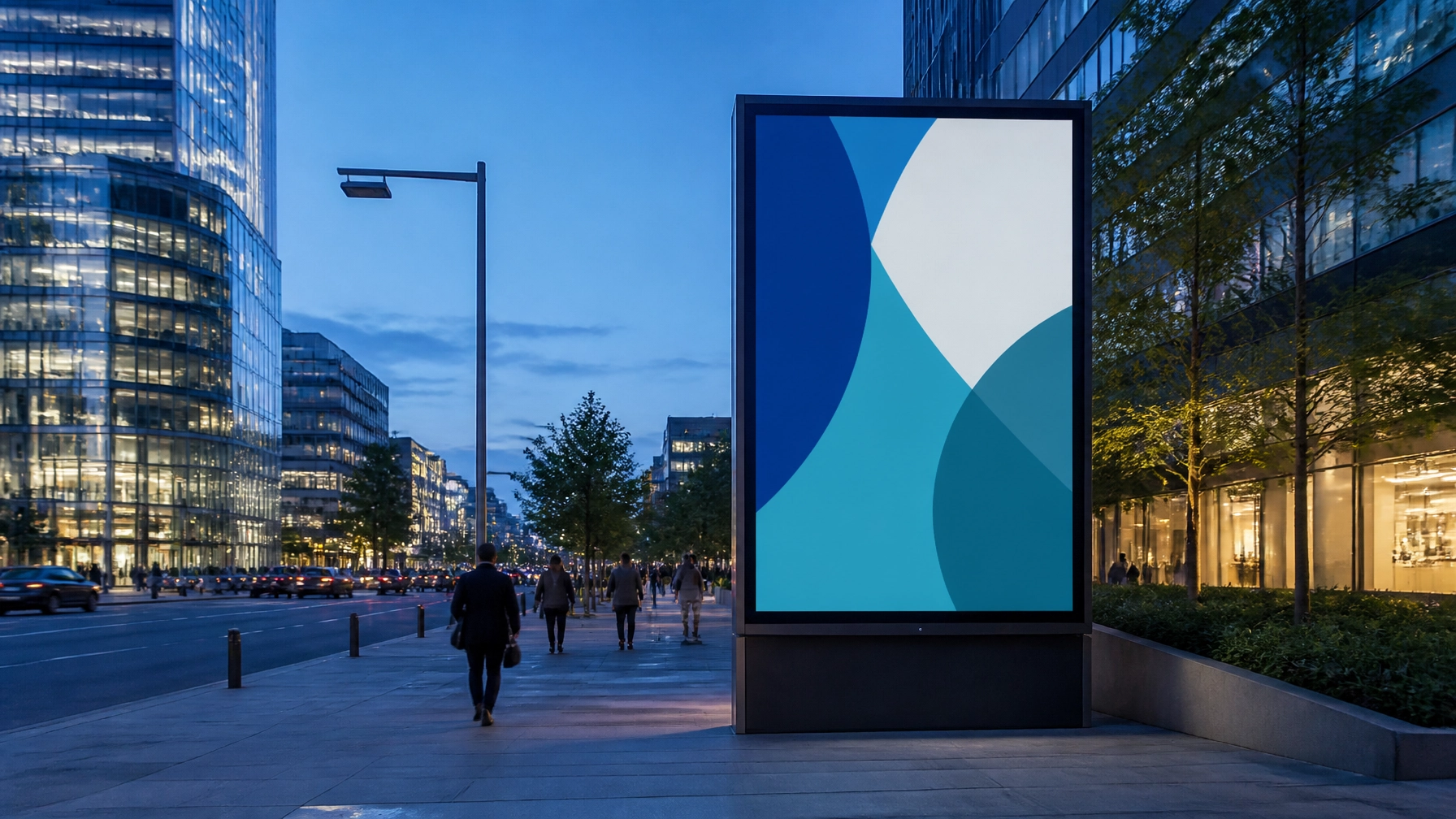
Build your DOOH campaign as a flexible system, not a single piece of creative. When you separate your brand’s lasting message from the elements that need to change, you can stay consistent across markets without becoming repetitive.
Evergreen DOOH should give your brand a reliable presence while allowing your message to respond to audience needs, venue context, market conditions, and business priorities. That balance matters for media buyers, planners, agencies, and in-house brand teams managing campaigns across multiple cities and customer segments.
Use the framework below to create DOOH campaigns that remain recognizable, useful, and relevant across markets.
Start with a Consistent Brand Foundation
Define the part of your campaign that should remain stable. This is not a slogan that must appear unchanged on every screen. It is the larger brand promise, visual identity, product benefit, or emotional idea that connects every execution.
Your evergreen foundation may include:
- A consistent color palette and visual language
- A recognizable product or brand presence
- A clear customer benefit
- A short, memorable message structure
- A repeatable call to action
- A tone that works across locations and audiences
Keep this foundation simple enough to travel. A campaign shown in New York should still feel connected to the same campaign seen in Los Angeles, Hong Kong, Paris, Munich, or Italy. At the same time, avoid forcing every market to use identical wording or imagery.
Think of your foundation as the campaign’s operating system. It provides structure, while the content displayed within that structure can change.
A strong foundation reduces production pressure and protects brand consistency. It also gives your team more time to improve strategy, targeting, and measurement instead of rebuilding every campaign from the ground up.
Use Modular Creative Instead of Repetitive Creative
Evergreen does not mean showing the same ad indefinitely. It means creating a flexible set of components that can be combined, adjusted, and refreshed without losing the central idea.
Build your creative in modules:
- Core message: The enduring reason your audience should care.
- Audience variation: A version written for a specific customer mindset.
- Venue variation: A message that fits the environment where it appears.
- Contextual layer: A response to weather, traffic, local activity, or an event.
- Scheduling layer: A message aligned with a daypart or recurring business need.
- Action layer: A relevant next step, such as visiting, learning, ordering, or planning.
This structure allows you to create variety without creating chaos. You can keep the same visual system while changing the headline, product emphasis, or call to action.
For example, a consumer brand may use the same evergreen product story across a grocery store, restaurant, transportation hub, sports bar, and medical office. The creative system remains recognizable, but each version speaks to the audience’s immediate setting.
Refresh the combinations, not just the artwork. That is how you maintain familiarity while preventing creative fatigue.

Match the Message to the Venue and Audience
Treat every venue as a different communication environment. The audience’s mindset, dwell time, and reason for being there should influence how your evergreen campaign appears.
Grocery Stores
Reach shoppers while they are already thinking about household needs, food, health, and value. Use clear product benefits, simple comparisons, or reminders that support purchase consideration.
Keep the message easy to process near entrances and checkout areas. Use stronger brand reinforcement in locations where people have more time to notice the screen.
Restaurants
Use creative that fits social, dining, and convenience-oriented moments. A brand can highlight ease, quality, refreshment, or an occasion without relying on a limited-time promotion.
Keep the visual tone warm and immediate, even if the wider campaign uses a consistent global design system.
Transportation Hubs
Design for brief viewing windows. Use large visual cues, minimal copy, and direct actions. Transportation audiences are moving, waiting, transferring, or planning their next destination.
A strong evergreen message here should be understood quickly and remembered later. Use the location to reinforce ideas such as reliability, movement, access, or readiness.
Sports Bars
Connect with audiences in a social and entertainment-focused setting. Creative can emphasize shared experiences, celebration, energy, or convenience.
Use event-aware variations when appropriate, but keep the core campaign available between major moments. This lets you build consistent brand presence instead of depending only on peak occasions.
Medical Offices
Recognize that waiting-room audiences may have more time to absorb information. Use calm visuals, clear explanations, and messages that support trust and consideration.
Avoid treating every venue like a roadside billboard. Allow the creative to breathe where dwell time is longer, while maintaining the same brand foundation.
Venue relevance makes evergreen content feel intentional. It shows that your campaign belongs in the environment rather than simply occupying available screen time.
Control Market Reach with the Right Radius
Use radius targeting as a planning tool, not a default setting. RAMM supports flexible radius targeting from 2.5 to 50 miles, allowing you to align campaign reach with audience behavior and business objectives.
Use a tighter radius when you need to influence nearby action. A 2.5-mile radius may suit a local retail location, restaurant, medical practice, or store-visit campaign.
Expand the radius when your audience travels farther or when your objective is broader awareness. A 10-, 25-, or 50-mile radius may be more appropriate for a regional brand, transportation service, major destination, or product with a larger consideration area.
Do not assume one radius should cover every market. Urban density, travel patterns, venue availability, and customer behavior vary significantly between New York, Los Angeles, Hong Kong, Paris, Munich, and Italy.
Build a repeatable decision process:
- Identify the audience you need to reach.
- Map where that audience shops, travels, works, and spends time.
- Estimate the practical travel area for the offer or product.
- Select a radius that supports the campaign objective.
- Compare performance across different radiuses.
- Adjust reach as your data improves.
This approach turns geographic flexibility into a long-term advantage. You can scale the same evergreen campaign while still respecting the realities of each market.
Schedule for Continuity and Change
Give your campaign a dependable presence, then create room for daily adjustments. Continuous scheduling helps maintain brand familiarity, while daily custom scheduling lets you respond to changing business conditions.
Use continuous campaigns when you need to:
- Build long-term awareness
- Reinforce a product category
- Maintain visibility across key markets
- Support a steady retail or service footprint
- Keep your brand present between major campaign launches
Use daily custom scheduling when you need to:
- Prioritize specific venues
- Increase presence during high-value periods
- Support changing inventory or store traffic
- Match local business hours
- Shift creative by daypart
- Adjust spend based on performance
The most effective evergreen campaigns often combine both approaches. Keep the brand foundation running consistently, then rotate audience, venue, and contextual modules around it.
This gives planners a dependable media structure without locking the campaign into a rigid schedule. It also gives in-house teams practical control when business needs change.

Add Triggers Without Letting Triggers Define the Campaign
Use event-based and weather-based triggers as supporting layers. They should make your evergreen campaign more useful, not replace its central message.
An event trigger can adjust creative around concerts, sporting activity, festivals, conventions, or other local audience shifts. A restaurant near a transportation hub may promote convenience when traffic increases. A consumer brand near a sports bar may emphasize social occasions during relevant programming.
Weather triggers can make the message more timely. Adjust the creative when rain begins, when temperatures shift, or when outdoor conditions change. For a rain-sensitive campaign, you may:
- Pause creative that promotes outdoor activity
- Shift toward indoor products or services
- Promote delivery, convenience, or shelter
- Move spend toward covered venues and transportation hubs
- Replace a weather-sensitive offer before it becomes irrelevant
Include a rain cancellation rule when running campaigns tied to outdoor behavior. It protects budget, reduces message waste, and gives your brand a more thoughtful presence.
The key is to keep the trigger modular. Let the condition change the context, headline, image, or destination. Do not rebuild the entire campaign every time the environment changes.
Create a Global System with Local Permission
Plan globally, then give each market enough flexibility to feel natural. RAMM’s presence across New York, Los Angeles, Hong Kong, Paris, Munich, and Italy gives brands a foundation for coordinated international DOOH planning.
Start with shared standards for:
- Brand identity
- Visual hierarchy
- Message priorities
- Creative specifications
- Measurement principles
- Approval workflows
Then allow local teams to adapt:
- Language
- Cultural references
- Venue mix
- Radius selection
- Scheduling patterns
- Local event context
- Weather responses
- Audience priorities
This balance prevents two common problems. The first is fragmentation, where every market looks unrelated. The second is over-standardization, where the campaign feels disconnected from local audiences.
Give local teams clear boundaries rather than complete freedom or complete restriction. A modular system makes that possible. Everyone works from the same foundation, but each market can make the campaign more relevant.

Measure the System, Not Just the Spot
Evaluate more than individual creative impressions. Evergreen DOOH works as a connected system, so your reporting should show how the parts work together.
Track performance by:
- Market
- Venue type
- Radius
- Daypart
- Creative variation
- Trigger condition
- Scheduling pattern
- Audience segment
- Business outcome
Look for patterns. Which venue types produce stronger engagement? Does a tighter radius support more store activity? Do contextual variations outperform the base creative? Does a daily custom schedule improve efficiency?
Use those findings to refine the system. Promote stronger modules, adjust underperforming combinations, and improve market-level decisions without discarding the campaign foundation.
RAMM supports data-driven campaign development, targeted placement, and performance tracking to help you make these decisions with greater confidence. Explore RAMM’s digital out-of-home advertising solutions and campaign development services to see how a flexible DOOH system can support your brand.
Turn Evergreen DOOH into a Long-Term Growth Engine
Build the foundation once, then keep improving how it works. An evergreen DOOH campaign should remain recognizable without becoming predictable, scalable without becoming generic, and consistent without ignoring local context.
Define your lasting brand idea. Break your creative into modules. Match messages to venues and audiences. Adjust the radius from 2.5 to 50 miles. Combine continuous visibility with daily custom scheduling. Add event and weather triggers, including rain-sensitive cancellation rules. Then measure each market and use the results to improve the next decision.
That is the evergreen advantage: you create a campaign system that can keep working across markets while staying responsive to the people and places it reaches.
Ready to build a more flexible DOOH presence? Visit RAMM Worldwide to explore your options. You can also encourage engagement by sharing your questions, campaign challenges, or ideas for keeping evergreen creative fresh.

