
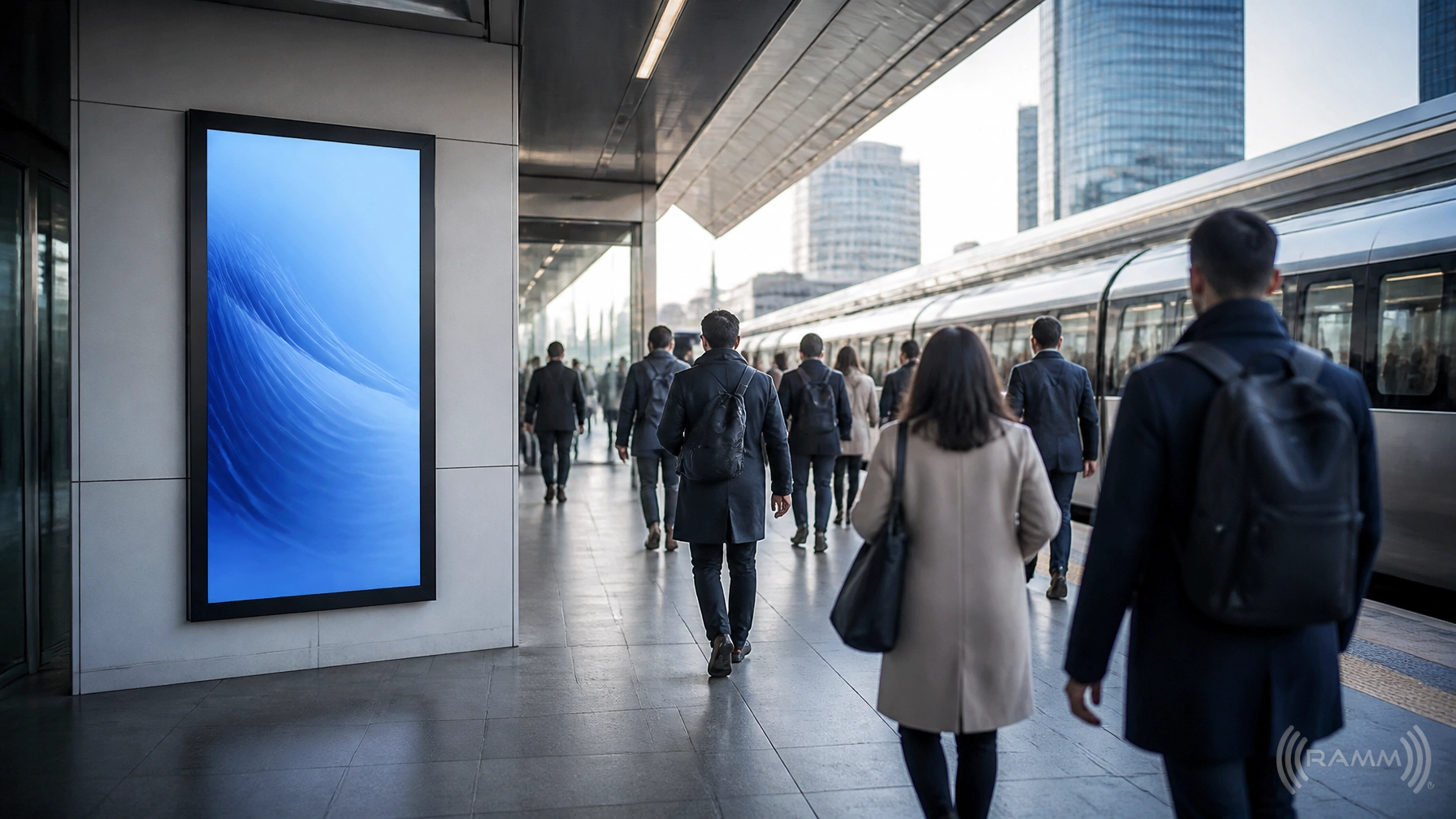
Win commuter attention by placing your message where daily movement, waiting time, and purchase intent naturally meet. Transport hubs give your brand access to people who are already traveling through predictable routes, pausing at familiar locations, and making decisions about what to do next.
That combination makes transit environments one of the strongest opportunities in digital out-of-home advertising. With the right venue targeting, flexible scheduling, and real-time triggers, you can turn a routine commute into a consistent brand experience.
Start With the Journey, Not Just the Demographic
Do not limit your audience strategy to age, income, or household profile. Start by understanding where your audience moves throughout the day.
Commuters pass through train stations, subway platforms, bus terminals, airport concourses, rideshare pickup areas, and parking structures. They wait, transfer, walk, and make last-minute decisions. Each point in that journey creates a different advertising opportunity.
A transportation hub can help you reach:
- Office professionals traveling into business districts
- Students moving between neighborhoods and campuses
- Parents and caregivers managing daily errands
- Travelers arriving for business or leisure
- Service workers commuting during early and late shifts
- Consumers passing near retail, dining, and entertainment districts
This is the advantage of venue targeting. You are not simply buying broad exposure across a city. You are selecting the places where your audience is most likely to be present and most likely to need what you offer.
Research from the Out of Home Advertising Study found that transit advertising is widely noticed, with many adults reporting recent exposure to ads in or around public transportation. The same research found that people are more likely to notice out-of-home advertising when it reflects their needs and the location where they see it.
Make your message fit the journey, and you give people a reason to pay attention.

Use the Hub to Build Repeat Attention
A commuter may see the same station or route several times each week. That repetition gives you something most digital placements cannot provide as consistently: a familiar point of contact.
Use this pattern to build recognition over time. Introduce your brand with a clear, memorable message during the morning commute. Reinforce the benefit in the evening. Then rotate in a product, offer, or next step once your audience knows who you are.
For example, a consumer packaged goods brand could use:
- A morning message focused on convenience
- An afternoon message reminding commuters to shop on the way home
- An evening message featuring a product solution for dinner or relaxation
- A weekend message tailored to leisure, travel, or household planning
Do not overload every impression with a different idea. Maintain a consistent visual identity and repeat your strongest benefit. Then use the flexibility of digital screens to adapt the context around that benefit.
A well-planned transit campaign can support awareness, consideration, and action without forcing one message to do everything at once. Keep the journey clear, and your audience will remain engaged from one exposure to the next.
Match Your Schedule to Commuter Mindsets
Run your campaign when your audience is most receptive to the message. A commuter’s mindset changes throughout the day, so your scheduling should change with it.
Morning rush hour: Build awareness and utility
Morning commuters are often focused on time, routine, and getting where they need to go. Use concise creative that introduces a helpful product benefit or a simple reminder.
This is a strong window for:
- Coffee, breakfast, and convenience products
- Health and wellness messages
- Mobile apps and digital services
- Daily-use household products
- Brand-building creative with broad appeal
Keep the creative direct. Use one visual idea, one benefit, and one easy action.
Midday: Reach flexible and local audiences
Midday traffic can include shoppers, students, visitors, service workers, and people moving between appointments. This audience may have more flexibility than the traditional commuter rushing to work.
Use this period to promote:
- Nearby retail locations
- Lunch and dining offers
- Personal care products
- Financial or professional services
- Local experiences and appointment-based businesses
Connect the message to the surrounding environment. A screen near a station exit can encourage a nearby visit. A display in an airport terminal can promote a travel-related service or product. A message in a bus terminal can offer a simple mobile action for the next stage of the journey.
Evening rush hour: Drive action
Evening commuters are often thinking about food, errands, entertainment, and home. Shift from broad awareness to immediate relevance.
Promote:
- Grocery and meal solutions
- Quick-service restaurants
- Streaming and entertainment
- Retail offers
- Delivery services
- Products that simplify the evening routine
Use clear calls to action such as “Shop nearby,” “Order now,” or “Find your closest location.” Add a QR code or short URL when it supports a meaningful next step.
Overnight and off-peak hours: Stay present with purpose
Do not assume the audience disappears after the main commute. Transportation hubs serve airport workers, healthcare staff, hospitality employees, overnight operators, travelers, and late-night customers.
Schedule overnight messaging for:
- Essential services
- Travel and lodging
- Late-night dining
- Healthcare and personal care
- Recruitment
- Brand awareness among shift workers
Your campaign does not need to run at the same intensity all day. Use continuous or daily custom campaigns to maintain presence where it matters, while directing more impressions toward priority windows.
Target the Venue Inside the Transit Network
Think beyond “the station.” Consider the specific environment within the station and the behavior taking place there.
You can target screens in:
- Station entrances and exits
- Platform waiting areas
- Transfer corridors
- Ticketing and ticket-validation zones
- Bus terminals
- Airport arrivals and departures
- Parking and pickup areas
- Nearby businesses along commuter routes
Each location offers a different level of dwell time and attention. A platform screen may support a short sequence of messages because people are waiting. An entrance display may require a fast, high-contrast message because people are moving quickly. A screen near a retail corridor can include a location-based call to action.
RAMM helps brands use targeted digital signage and data-driven media buying to connect with audiences in high-traffic locations. Learn more about the company’s approach on the RAMM About page.
Select the venue based on the decision you want to influence. Then build creative for the pace, mindset, and physical setting of that venue.

Trigger Creative Around Events and Local Conditions
Make your campaign responsive to what is happening around the commuter route. Digital out-of-home gives you the ability to update messages without replacing physical materials, which creates more opportunities for timely communication.
Use event triggers around:
- Concerts and festivals
- Conferences and trade shows
- School and campus activities
- Retail openings
- Local cultural events
- Holiday travel periods
- Major business or civic gatherings
For example, activate pre-event messaging during the afternoon commute, then shift to arrival-focused creative as the event approaches. Afterward, use departure routes to promote nearby restaurants, hotels, retail, or follow-up actions.
Weather triggers can also make transit creative more useful. Promote warm beverages during cold conditions, rain-ready products during wet commutes, or indoor destinations when outdoor plans change. If a weather event disrupts an outdoor activation, pause the campaign or switch to a more relevant message.
RAMM’s guide to weather-triggered DOOH campaigns explains how contextual changes can improve relevance. You can also explore event-based DOOH strategies for ideas on adapting campaigns around audience movement and real-world conditions.
The goal is not to add complexity for its own sake. Use triggers when they make the message more timely, useful, or actionable.
Measure More Than Impressions
Set measurement goals that reflect the role of the commute in your customer journey. Awareness is important, but it is only one part of the story.
Track indicators such as:
- Reach and frequency among the selected transit audience
- Performance by station, route, or venue type
- Engagement with QR codes and short URLs
- Website visits during and after scheduled placements
- Store visits near targeted transportation hubs
- Response differences between morning and evening creative
- Performance during event or weather-triggered periods
Compare creative by context, not just by total delivery. A message designed for the morning rush should not be judged against an evening offer without considering the different objective.
Use the results to refine your venue selection, scheduling, creative rotation, and calls to action. Over time, your campaign becomes more precise because each commuter exposure contributes to a clearer understanding of what works.
Make the Commute Work Harder for Your Brand
Transport hub DOOH wins because it meets people in motion without depending on a scroll, click, or search. It reaches commuters at repeatable points in their daily routine, gives your brand room to build familiarity, and allows you to adjust the message as the day changes.
Target the venue. Match the schedule to the mindset. Use event and weather triggers when context matters. Keep the creative simple, visible, and useful.
Then turn the daily grind into a dependable opportunity for attention and action. Visit RAMM to explore a targeted digital out-of-home strategy for your next commuter-focused campaign, or contact the team to start a conversation.

